For SMEs
Business software that adapts.Not you to the software.
Most companies start with business software from a standard package. One day you find yourself bending the way you work to fit what that package allows. That is the moment to do the maths.
What is business software?
Seven kinds of business software.That most companies use side by side.
Business software is all the software you use to organise your work. Rarely one package, almost always a handful that need to talk to each other.
Invoices, VAT and payments. A package is almost always enough here, and we leave it in place.
Sound familiar?
Four moments.When it starts to chafe.
Usually it is not one big problem, but a pile of small workarounds.
The module you half use
You need one feature and buy a module of which you open a tenth.
The monthly workaround
Every month the same export, the same shuffle in Excel, the same import somewhere else.
The meeting about the package
You no longer discuss how you want to work, but what the package allows.
The spreadsheet next to the system
Next to your software runs a file nobody officially maintains and everyone relies on.
Why Hubigen
One environment, built around you.That is why companies choose us.
What you get, and when it clicks.
What you get
- Agreements on the build, hosting, maintenance and later changes.
- Starting with a clearly defined process and expanding phase by phase.
- Integrations with your accounting, webshop, planning or warehouse.
- History and open files come along.
- Software that is yours, including the code and the data.
When you choose us
- You want the software to follow how you work.
- You want to stop doing the same export and import every month.
- You want one environment instead of separate tools and spreadsheets.
- You want to start with the process that costs the most time.
- You want a partner who sticks around after go-live.
What we build
One environment.Connected to what keeps running.
Custom business software
One environment for the processes your package does not cover.
Custom ERP
Planning, stock, purchasing and finance that know each other's figures.
Integrations
With your accounting, webshop, planning or warehouse.
Roles, permissions and reporting
Everyone sees exactly what they need, and the figures you steer by update themselves.
Approach
From process to go-live.In fixed phases.
After each phase we review how it works and discuss the next step. Changes are recorded separately.
Mapping the processes
The way they really run, workarounds included. Those workarounds are the brief.
Keeping what works
Your accounting usually stays. We only replace what is itself the problem.
Starting with the costliest process
Not the easiest one. Whatever costs the most time or errors goes first.
Live with your own data
History and open files come along. Nobody starts from empty.
Proof, not promises
Companies already doing it.And not looking back.
From separate tools and spreadsheets to one environment that follows the work.
In practice
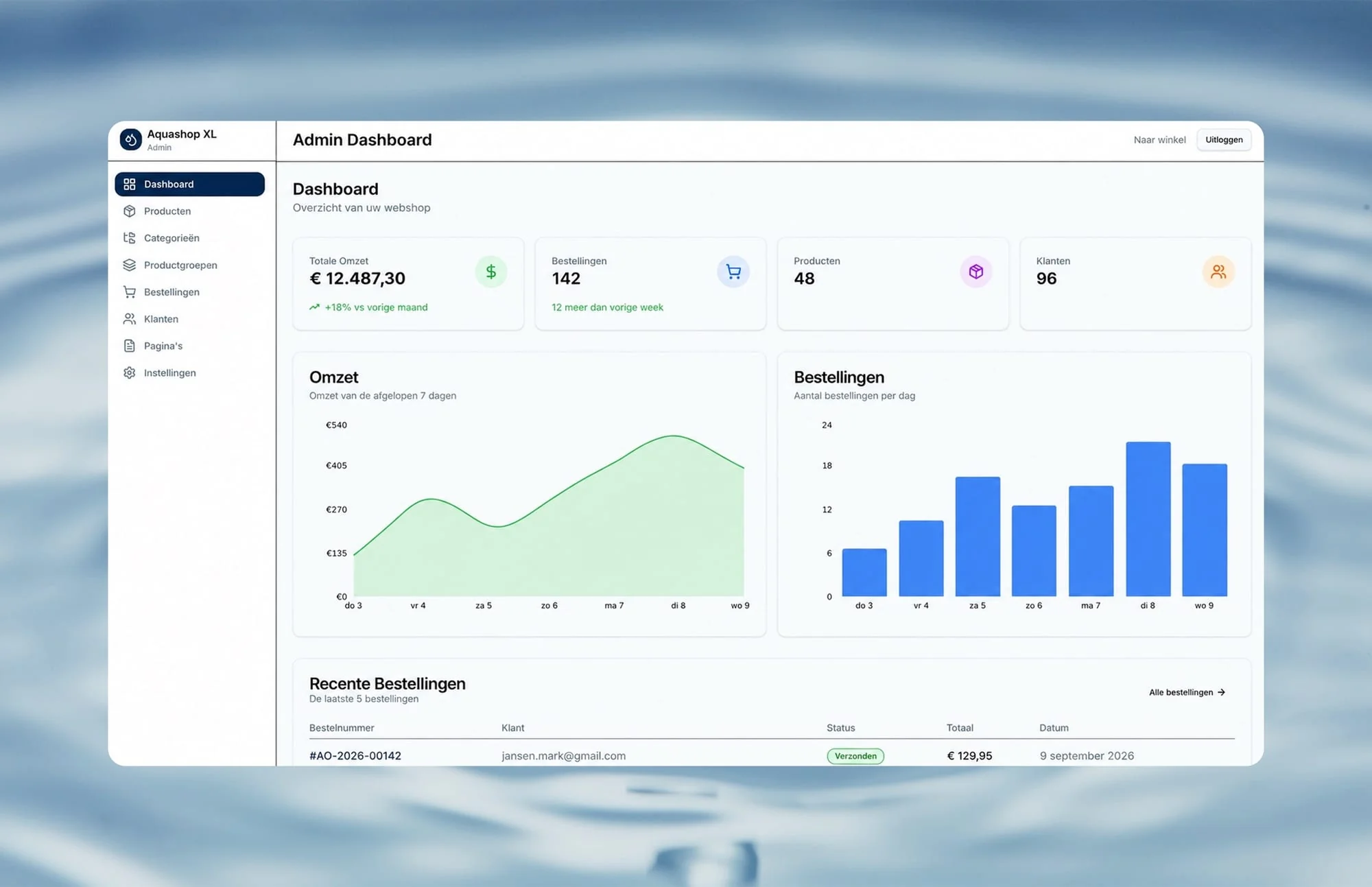
How we did it at Hubigen Admin
For our own agency we built Hubigen Admin with roadmaps, task briefings, hours, invoicing, CRM and Docs. The platform follows how our daily work fits together, from first question to delivery and follow-up.
Get to know us
Which tools are you sticking together today?Show us how the work runs today.
We will tell you honestly whether one business platform pays off, and where best to start.
Questions
What clients ask us.About integrations and what you already use today.
All the software a company uses to organise its work: accounting, CRM, ERP, planning, time tracking, quotes and invoicing. Most companies use a handful side by side. The difference between a good and a bad setup rarely lies in one package, but in how those packages talk to each other. Whatever does not connect gets retyped by hand.
A standard package is enough as long as the way you work resembles the rest of your sector. Once you start bending your processes to what the package allows, or you buy modules you only half use, the balance tips. Another tipping point is integrations: if you retype data between systems, you pay every month for something you could solve once.
That depends on how many processes go into it and which systems we connect to. We work with a fixed price per phase, so you know where you stand up front and decide yourself after each phase whether we carry on. Besides the build, include hosting, maintenance, integrations and later changes in the comparison.
No, and we advise against it. We start with the process that costs the most time or causes the most errors today, and connect it to what is already running. Your accounting package can simply stay. We only replace something when the existing system is itself the problem.
We look at which integrations and exports your package offers. What works well can stay, while we build the missing steps or screens alongside it. The options depend on the package, the version and the access available.
You do. You are not renting a licence and you are not tied to us to move forward. That is one of the fundamental differences from a package: with custom work, you decide what happens if you want something different in three years' time.
The timeline depends on the features, integrations, data migration and feedback. We first discuss the first version and what information it needs.
Contact
Work together?Tell us what you want to build.
Curious what we can do for you?Leave a short message about your question or project.